
Home / Machines / Spinner Hanger Shot Blasting Machine for Coating Preparation
Spinner Hanger Shot Blasting Machine for Coating Preparation
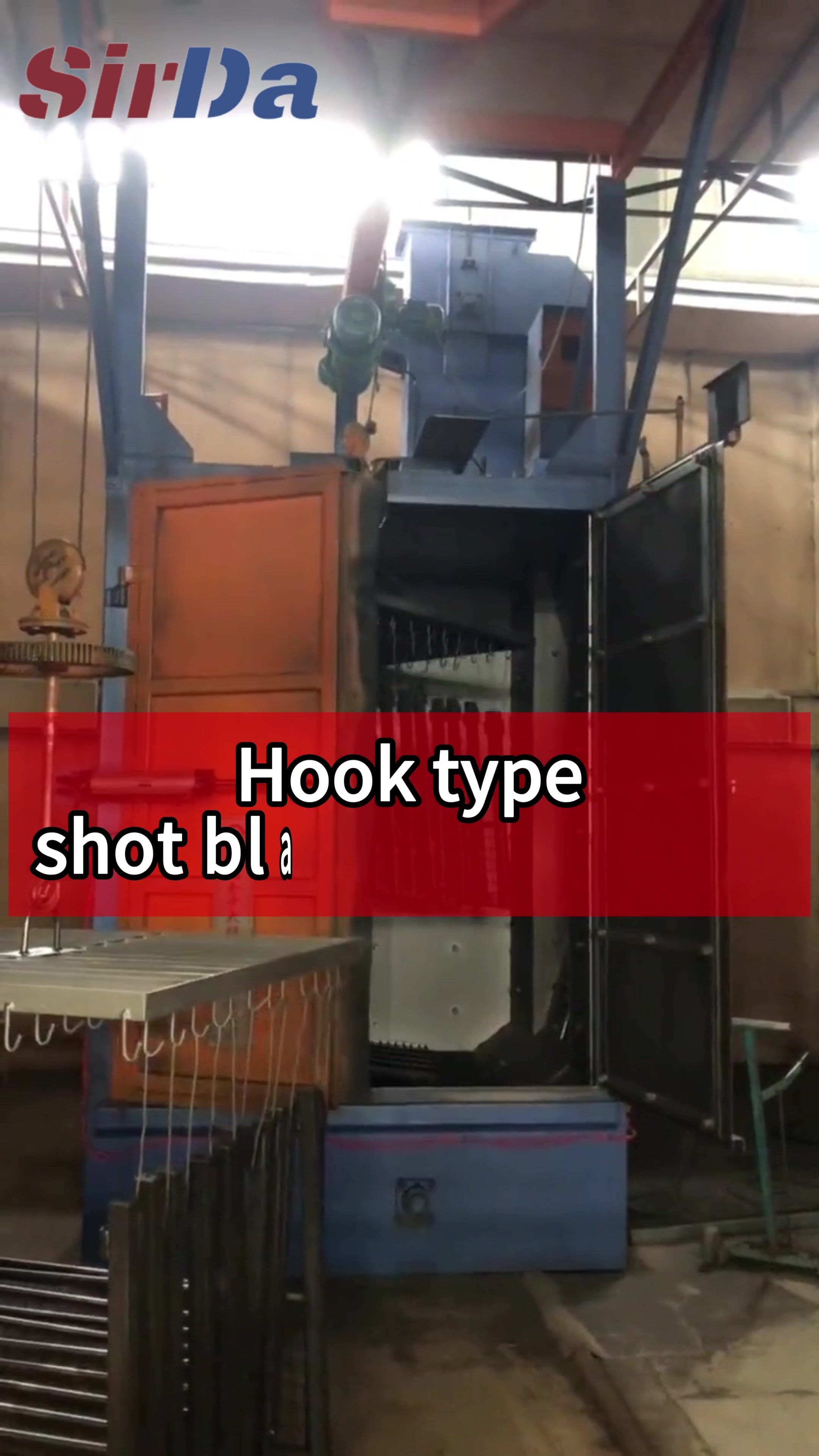
A batch shot blasting machine with rotating hanger hooks, built for workpieces that are too heavy to tumble and too awkward to lay on a conveyor. Removes rust, mill scale and old coating to prepare steel and fabricated parts for painting or powder coating.
PREPARE FOR
WHAT’S NEXT.
Match workpiece handling, blasting configuration and production flow to your application.
Request a quotationDesigned Around the Workpiece, Not the Machine
A spinner hanger machine solves a narrow problem very well. Parts arrive that are too heavy to tumble, too fragile to roll on a conveyor, or too irregular to sit still — welded fabrications, structural sections, tank shells, machine housings, castings with deep pockets. You cannot throw them. You can only hang them.
The workpiece is therefore suspended from hooks on a horizontal shaft that rotates through the blast chamber. As the shaft turns, every hook traces its own circle, and the blast stream sweeps the part from one face, around the edge, to the other. Nothing has to be repositioned by hand, nothing has to be indexed on a fixture, and the operator loads once instead of turning each part by hand between passes.
That rotating shaft is the whole idea. Everything else in the machine — chamber shape, blast wheel placement, nozzle angle, dust extraction — exists to serve it.
What the Rotating Hook Actually Changes
- Every face is approached, not just the visible one — The rotation means a hung part receives blast from the full sweep of the nozzle bank rather than from one fixed direction. Internal corners and the reverse face are cleaned without turning the workpiece.
- Uniformity across a batch — Because each hook follows the same path and the same cycle time, parts hung on the same shaft finish consistently. That consistency is what makes the machine usable in a production line rather than a one-off job shop.
- No manual re-hanging — A conventional hanging machine needs the operator to walk the chamber and rotate parts. Automation here is mechanical rather than robotic, which keeps the cost and the maintenance surface low compared with a robot cell.
- Heavy parts stay supported — Load is carried by the shaft and the hanger, not by a belt, a table or a tumbling drum. Weight capacity is therefore limited by the shaft and drive rather than by anything the part could be damaged by.
- Abrasive stays in circulation — Screw conveyor, bucket elevator and separator return the media to the blast wheel, so media consumption stays predictable across long runs instead of degrading as it would in a single-pass arrangement.
- Dust is extracted, not exhausted — Bag and cartridge filtration keeps the abrasive and the removed scale inside the machine, which protects the operator and lets the recovered media go back into the cycle.
Where It Fits, and Where It Stops
The natural fit is batch work on heavy or awkward parts in a moderate size range: fabrications, structural steel sections, pressure parts, castings, machine frames and housings. Where parts are consistent in weight and shape, the machine pays back quickly through batch uniformity and low handling labour.
The boundaries are worth stating plainly. A spinner hanger is a batch machine, so it does not suit high-volume continuous production where parts must flow through without stopping — that is continuous-flow equipment. It is also not the right choice for very small parts, which belong in a cabinet or a tumble belt, nor for very long components that will not clear the chamber with room to rotate.
Preparation quality is only part of the job. A cleaned surface has to match what the coating system expects, and that expectation comes from the coating supplier, not from the machine. The cleanliness grade, the profile left behind, and the acceptable residue are agreed per workpiece before anything is specified.
What We Confirm Before Quoting
A spinner hanger is a configured machine, not a catalogue item. The following points determine the configuration, and we confirm them against your actual parts before any specification is issued:
- Workpiece envelope, cross-section and weight per hook
- Hanging orientation, hook spacing and how parts are fixtured
- Surface condition and what has to be removed
- The cleanliness grade and coating system the parts are destined for
- Batch size and required throughput
- Degree of automation expected at loading and unloading
- Dust extraction routing and available space
- Power supply and compressed air on site
Once these are clear, the chamber size, shaft capacity, blast wheel arrangement and filtration are matched to the workload rather than to a price point.
DEFINE THE CONFIGURATION.
- Workpiece
- Geometry, envelope and weight per hook
- Hanging method
- Hook orientation, spacing and fixturing
- Surface condition
- Rust, mill scale, paint or casting residue to remove
- Target finish
- Cleanliness grade agreed against the coating specification
- Cycle
- Batch size and required throughput
- Automation
- Loading, unloading and cycle control level
- Dust handling
- Filtration requirement and exhaust routing
- Site services
- Power supply and compressed air availability
BRING US YOUR WORKPIECE.
Share a photo or drawing, material, maximum dimensions and expected output. These details help us review a suitable configuration.
Send project requirements