
Home / Machines / Auto Loading Crawler Belt Shot Blaster for Forged Parts
Auto Loading Crawler Belt Shot Blaster for Forged Parts
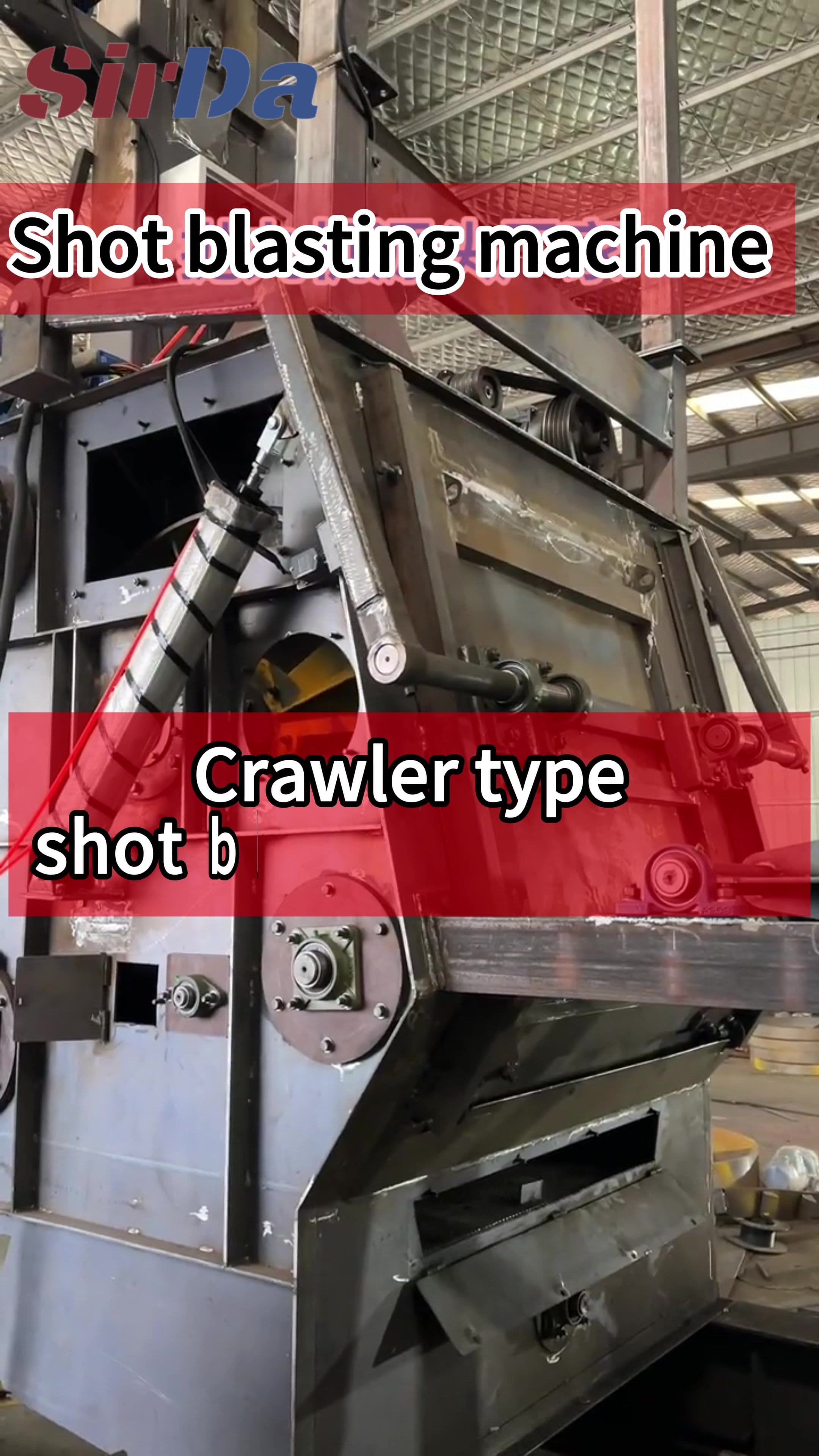
A crawler belt shot blasting machine that loads and unloads automatically and cleans forged parts, machined steel components and castings in batches, using cantilevered centrifugal blasters and a sealed cabinet with pulse dust filtration.
PREPARE FOR
WHAT’S NEXT.
Match workpiece handling, blasting configuration and production flow to your application.
Request a quotationForged components are the awkward case in shot blasting. A forged bracket or flange arrives with mill scale, rust and forging residue packed into the grain, but the same part is already dimension-critical: a pebbled surface, a rounded edge or a stretched thread means a scrapped downstream weld or a failed mating face. The handling system has to move the part through the blast zone without adding damage of its own.
Why the Crawler Belt Matters
A crawler belt is a continuous rubber loop that advances workpieces across the blast zone in overlapping stages. Unlike a roller conveyor, it never exposes a seam between workpieces for abrasive to catch on, and unlike a hook conveyor it does not hang the part by a hole that has to be drilled and later plugged.
- No seam transfer — the closed rubber loop carries each part forward without an intermediate joint, so there is no line of shadow where media cannot reach
- Gentle support — the belt flexes around the workpiece rather than clamping it, which matters for parts that deform easily when fixtured too rigidly
- Wear-tolerant — the rubber track is a consumable that can be replaced without opening the blast cabinet internals
- Quiet in operation — elastomer contact dampens the impact noise a hard-linked conveyor would generate
What the Cabinet Is Doing
Media is thrown by cantilevered centrifugal blasters, and the shot stream is directed at the faces that need it rather than swept across the whole envelope. Because the blasters are cantilevered, the impeller and blade assembly can be serviced from one side without dismantling the cabinet.
Around the blast zone, pulse filter cartridges capture what the media knocks loose, and the extracted air is returned to the plenum rather than exhausted. That closed loop is what keeps the surrounding area usable when the machine runs next to other equipment.
- Cantilevered blasters — single-side access for blade changes and impeller inspection
- Sealed cabinet with pulse filtration — dust stays inside the enclosure instead of entering the workshop
- Automatic load and unload — parts advance without an operator standing over the belt
- Adjustable conveyor speed — dwell time under the shot stream is tuned to the part, not fixed by the machine
Where It Fits, and Where It Does Not
This machine suits the mid-size batch job: forged parts, machined steel components, castings that need oxide and residue removed before finishing, and hardware that arrives in manageable baskets. The common thread is a part that is dirty on arrival, structurally sound, and needed in a clean state somewhere downstream.
It is not the answer for a very large or very heavy component that would overhang the belt, for a fragile thin-walled part that needs support at more than one point, or for a line that requires a fixed continuous throughput measured in parts per minute. A crawler machine is a batch machine, and treating it as a continuous line is where expectations get expensive.
What We Need From Your Workpieces
The configuration depends on geometry rather than catalogue numbers. To quote this properly we need the largest part in the basket and its smallest, the weight of the heaviest piece, whether any surfaces are finished surfaces that must stay untouched, the removal standard you are working to, and your expected batch size per cycle. Cycle time and media consumption follow from those answers.
DEFINE THE CONFIGURATION.
- Workpiece
- Forged parts, machined steel components and castings
- Handling
- Crawler belt conveyor with automatic load and unload
- Surface removal
- Mill scale, rust and forging residue
- Blast media
- Cantilevered centrifugal blasters, media selected to suit the part
- Dust control
- Sealed cabinet with pulse filter cartridges
- Configuration
- Reviewed against part geometry, weight and finish requirement
BRING US YOUR WORKPIECE.
Share a photo or drawing, material, maximum dimensions and expected output. These details help us review a suitable configuration.
Send project requirements