What CE marking actually covers for a blast machine
The CE mark on a blast machine is a manufacturer's own declaration, not a third-party certificate. Here is what it legally covers, the four documents that must agree with each other, and the blast-specific hazards where conformity most often breaks down.
What the CE mark is, and what it is not
The CE mark is not a quality award, and it is not a third-party certificate. It is the manufacturer's own declaration that a machine meets the essential health and safety requirements of the EU legislation that applies to it. Nobody applies it casually, but nobody independent audits it either, unless the machine falls into one of the categories where a notified body must be involved. A conventional blast machine does not. That makes the mark a statement of legal responsibility rather than evidence of independent verification.
That distinction shapes how you read a supplier's offer. The useful question is not whether a certificate exists. It is which legislation the declaration names, which harmonised standards it cites, and whether the machine described in the document is the machine that will be bolted into your line.
The four documents that have to agree
Compliance rests on a small set of documents that must all describe the same machine. If they disagree on the serial number, on the model designation, or on the applicable directives, the whole file is worth very little.
- The nameplate — must carry the business name and full address of the manufacturer, the designation of the machinery, the series or type designation, the serial number, and the year in which the manufacturing process was completed. It must be in an official EU language, which does not have to be the national language of the country where the machine is installed.
- The declaration of conformity — Annex II of the Machinery Directive 2006/42/EC sets out what it must contain: the identity and address of the manufacturer, the name and address of the person authorised to compile the technical file, a description identifying the machine including model, type and serial number, an express statement that the relevant provisions are fulfilled, references to the harmonised standards applied, other standards used, place and date, and the identity and signature of the person empowered to sign.
- The technical file — a general description, drawings and circuit diagrams, calculation notes, test results, the risk assessment showing which hazards were identified and which protective measures reduce them, and the instructions for use. It must be available to authorities for at least ten years from manufacture, or for series production from the date the last unit was built.
- The instructions for use — must state the intended use, the residual risks that remain despite the protective measures fitted, what the user must still do to stay safe, maintenance points, and what to do in the event of a breakdown.
For a manufacturer established outside the EU, the person authorised to compile the technical file must be established in the EU. In practice that means appointing an authorised representative who holds the technical file and the declaration, and who can produce them when a market surveillance authority makes a reasoned request. Registration of the machine is not enough on its own; there has to be a named economic operator addressable inside the Union.
Where a blast machine gets caught
Generic machinery requirements are the easy half. The blast-specific hazards are where conformity usually breaks down, because they depend on how the machine is actually installed rather than on how it was built.
- Chamber access — opening a door must remove power from the blast wheel drive, not merely stop it through the control software. A software-only stop leaves stored energy available and does not satisfy the requirement.
- Dedusting — the machine must be arranged so that blasting cannot run without technical ventilation, and the extraction must actually clear the dust from the chamber. Exhaust air recirculated back into the working area requires a fine control filter upstream.
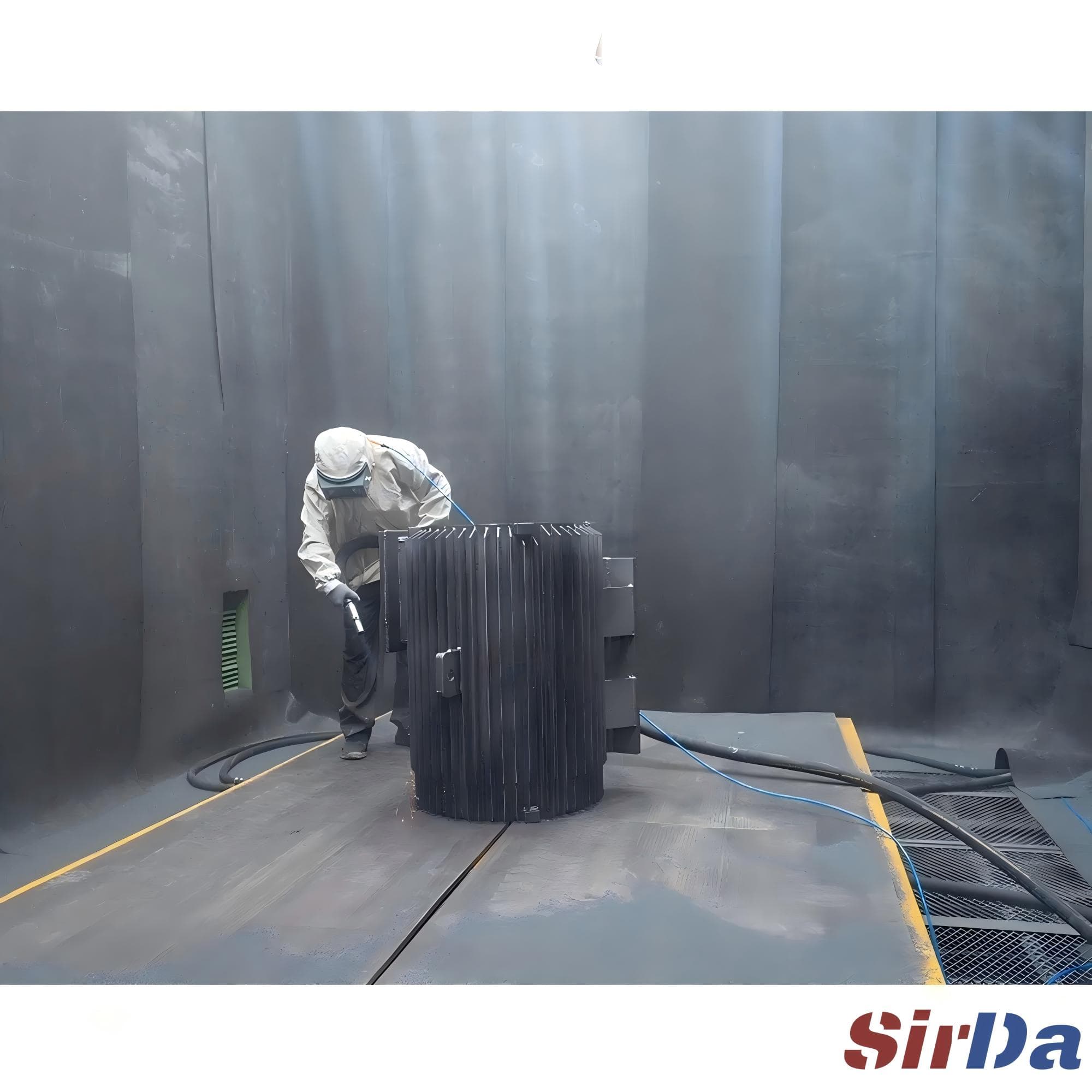
- Explosion protection — required where the dust generated is explosive. Ignition sources have to be avoided, ducting has to be pressure-shock resistant and earthed so that electrostatic charging cannot occur, and equipment installed in a potentially explosive atmosphere must be marked as such. Light metal workpieces with alumina or ceramic media produce the most dangerous combinations; steel parts with steel media sit much lower on that scale.
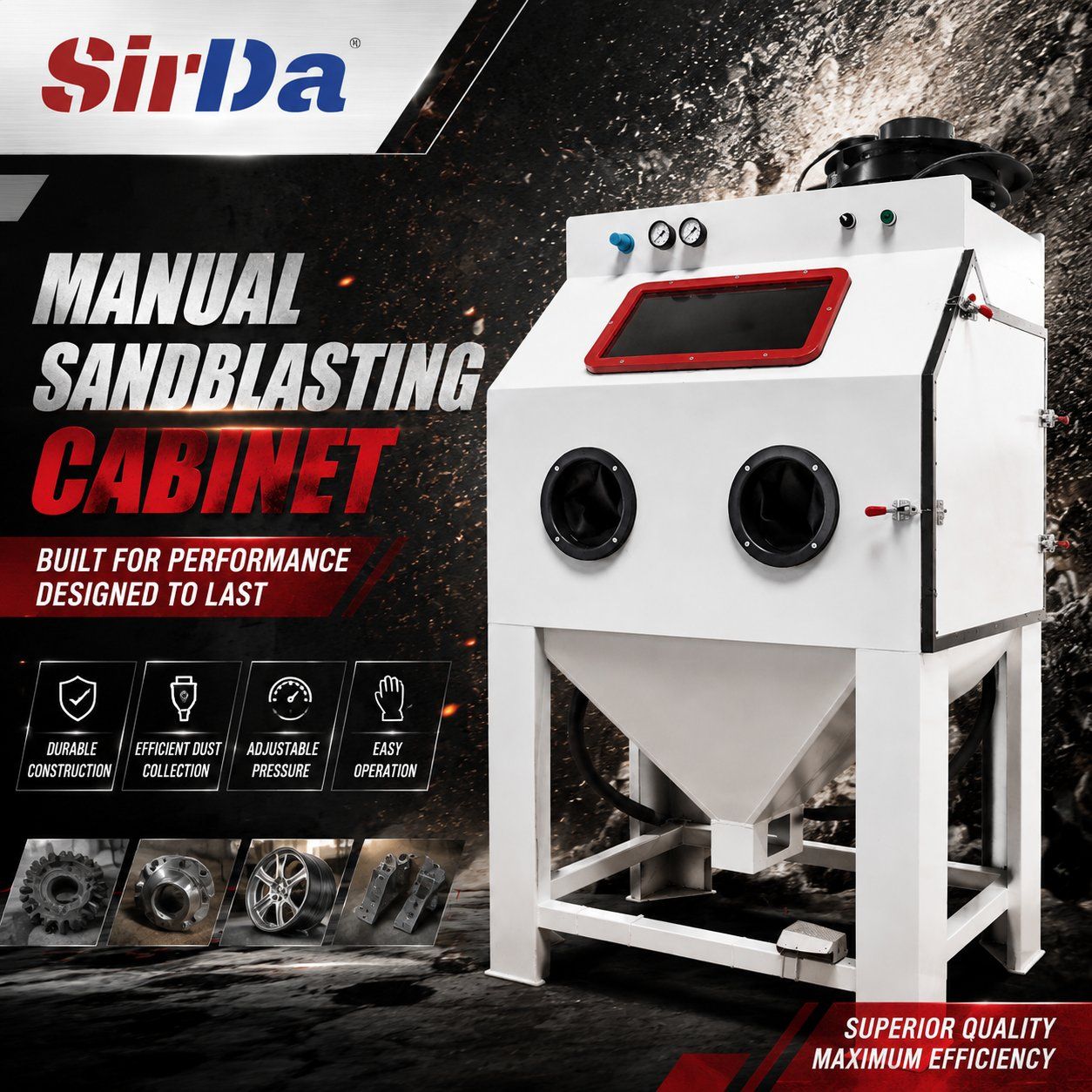
- Free-blast rooms and manual cabinets — need a device that stops blasting when the operator releases control, a control device on the blasting hose, and provision for a connection to forced-ventilated respiratory protection.
- Access and housekeeping — tripping edges in the chamber floor must be avoided, closing edges on automatic doors must be secured, dangerous movements must be guarded, and the escape route has to be illuminated.
None of this is visible from a catalogue page. It has to be verified against the documentation, or on site.
Reading an offer critically
The fastest way to sort a serious supplier from a quick one is to ask for the declaration and the technical file before asking for the price, and then check three things. Does the serial number range on the declaration match what will be shipped. Are the cited harmonised standards actually appropriate to a blast machine, or only general machinery standards. And is the ventilation interlock described as a hardwired permissive or as a software condition.
Expect a specific answer to when the Machinery Regulation (EU) 2023/1230 begins to apply. It becomes mandatory on 20 January 2027 and repeals Directive 2006/42/EC on that date. There is no transitional period for machines placed on the market, so anything being quoted now still falls under the Directive, while machines designed for delivery after that date need to be assessed against the Regulation, including its provisions on safety functions driven by artificial intelligence and on cyber-security for compliance-relevant control software.
A supplier who cannot tell you which legislation a given serial number was built under has not assembled a file worth auditing. Once that question is answered cleanly, the remaining technical conversation — media type, throughput, chamber geometry, dust load — becomes much easier to have on solid ground.