
Surface prep for hot-dip galvanizing: what the fab shop needs
Zinc does not bond to dirty steel, which makes hot-dip galvanizing self-checking. Where abrasive blasting fits in the degrease-pickle-flux chain, why preparation before galvanizing and touch-up after it demand opposite media, and how to size nozzles, airflow and dust collection honestly.
What the kettle actually demands
Hot-dip galvanizing is unforgiving in a way that most coating specifications are not. Zinc will not metallurgically bond to steel that carries oil, oxide, mill scale, paint or welding slag — it simply retreats. The useful consequence is that galvanizing carries its own quality control. When a part is drawn from the bath at around 450 degrees Celsius, every area that was not properly prepared sits there visibly uncoated, and the defect is caught on the hook rather than six months later under a coating.
The classical surface preparation chain has three stages, and abrasive blasting is one of them, not an alternative to them:
- Degreasing — a hot alkali, mild acidic or biological bath lifts dirt, paint markings, grease and oil off the metal.
- Pickling — dilute hot sulfuric acid or ambient hydrochloric acid strips mill scale and iron oxides. Abrasive cleaning can substitute for this stage or supplement it.
- Fluxing — a zinc ammonium chloride solution removes remaining oxides and deposits a protective film so the surface does not re-oxidize before immersion. In wet-process galvanizing the flux floats as a blanket on top of the bath; in dry-process galvanizing the part is pre-fluxed and dried first.
Epoxies, vinyls, asphalt and welding slag will not come off in a caustic bath. Those have to come off mechanically, by blast or grinding, before the part ever reaches the kettle. This is the stage where a fabrication shop earns or loses its coating.
Design matters as much as preparation. ASTM A385 governs the provision of high-quality zinc coatings, and its requirements are mostly geometric: vent and drain holes, cropped gusset plates and seal-welded overlapping surfaces are what allow zinc to reach internal corners and escape again. Steel chemistry matters too. Silicon and phosphorus outside the ranges ASTM A385 prescribes drive coating thickness well above the specified minimum, and an over-thick coating is exactly the kind that delaminates when a part is dropped during erection.
Two blasting jobs that want opposite abrasives
This is the mistake that costs fabricators the most: treating preparation before galvanizing and touch-up after galvanizing as the same operation. They are opposites.
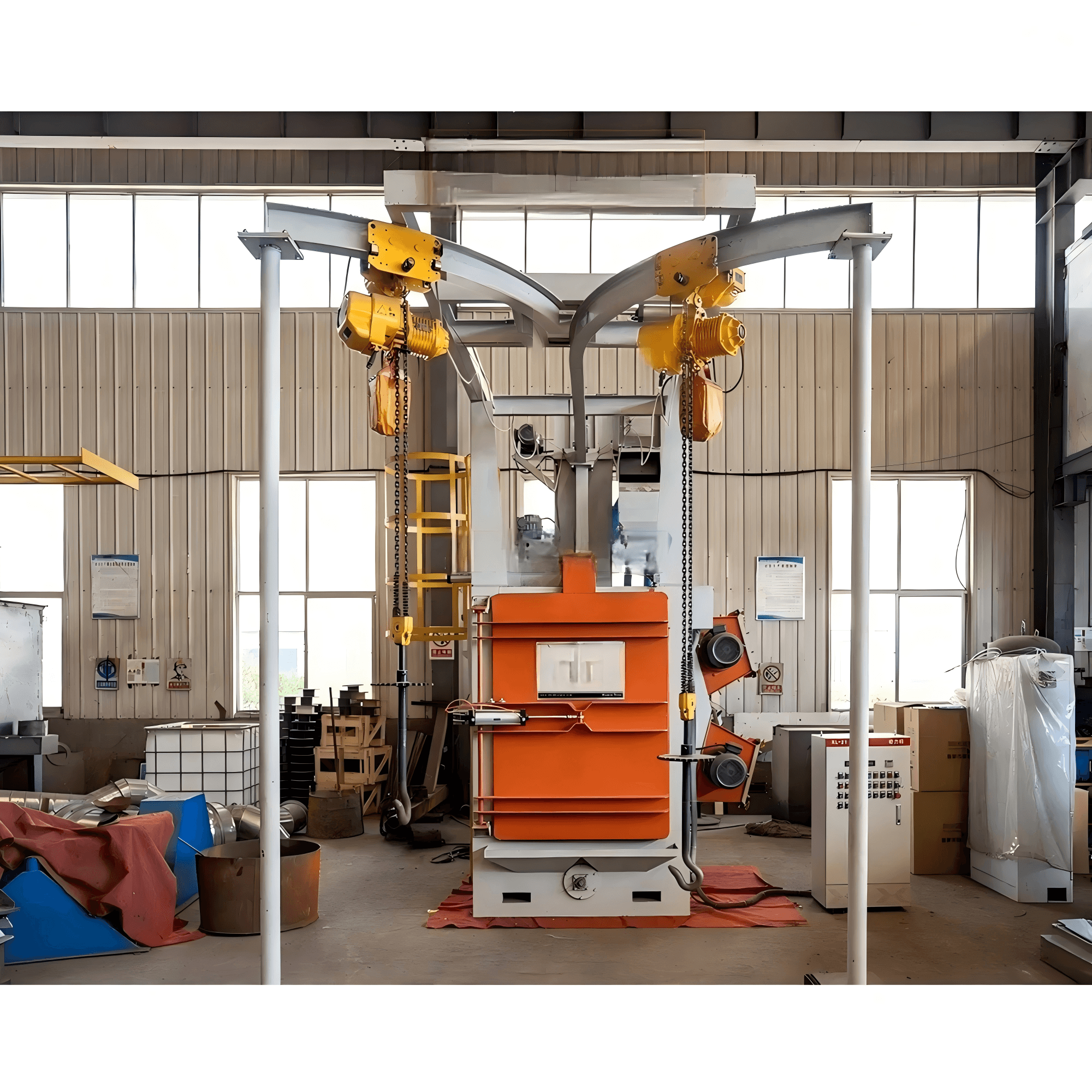
Before galvanizing, aggressive ferrous media is exactly what you want. Steel grit at Mohs 6 to 8, or steel shot at Mohs 5 to 6, cuts through mill scale, weld slag and shop paint, and leaves an anchor profile the coating can key into. Cleanliness targets at this stage are usually written as Sa 2½ or Sa 3 to ISO 8501-1 — very thorough or visually clean steel — with all oil, grease, dirt and foreign matter removed. SSPC-SP 10 with NACE No. 2, and SSPC-SP 5 with NACE No. 1, are the equivalent US references.
After galvanizing, when a duplex system or a field repair calls for the zinc surface to be roughened so paint will bond to it, the abrasive has to be soft. The industry specification on sweep blasting, SSPC-SP 16, limits how much zinc may be taken off — up to 25 micrometres, roughly one thousandth of an inch — and calls for a rapidly moving nozzle rather than a slow dwell. Media named as workable include aluminium/magnesium silicate in the 200 to 500 micrometre range, soft mineral sands at Mohs 5 or less, organic media such as corn cobs or walnut shells, corundum, limestone and cast zinc shot. Media at Mohs 5 and above, or with a bulk density over 200 pounds per cubic foot, will roughen the surface — but they also raise the peak height, and the blaster has to work hard to hold the coating damage down.
For a duplex coating the shop typically sweep-blasts with salt-free garnet, keeping the zinc layer intact while establishing a mechanical anchor for the primer.
Sizing the blast: nozzle, airflow and honest cycle time
Cycle time on a galvanizing prep line is arithmetic, not guesswork. Start from the blastable surface area, divide by a coverage rate, then add load and unload. Coverage rates scale hard with nozzle bore and pressure, and bore scales faster than pressure — bore enters most calculations as a squared ratio while pressure enters roughly linearly. A 3/8 inch nozzle at 100 psi is a workable reference point: roughly 80 to 120 square feet per hour to a commercial finish under SSPC-SP 6, 50 to 80 to near-white metal under SSPC-SP 10, and 25 to 50 to white metal under SSPC-SP 5. Field production frequently lands 20 to 40 percent below catalogue numbers once containment, dust control, rigging and media screening are counted honestly.
Airflow is where shops get caught. Measure pressure at the nozzle, not at the compressor, and remember that every 50 feet of hose costs roughly 3 to 5 psi. A 3/4 inch bore nozzle at 90 psi draws on the order of 80 to 90 CFM, while a 1/4 inch bore nozzle draws a small fraction of that. Size the compressor to exceed nozzle demand by 25 to 50 percent so pressure does not cycle while you blast. Media consumption on a heavy line runs 300 to 800 pounds per hour per nozzle, and that number decides whether you need a recovery system at all.

Dust, airflow and the failure modes worth naming
Abrasive blasting produces a high concentration of respirable particulate, and in the United States OSHA 29 CFR 1910.94 is the controlling regulation. Blasting should be performed in a closed cabinet or enclosure, exhausted so that no visible dust escapes and the operator's breathing zone stays below the permissible exposure limit — typically 10 milligrams per cubic metre for inert dusts, and lower for silica-bearing media. Size the dust collector at 1.0 to 1.2 times the cabinet exhaust requirement, keep cartridge filter area in the range of 4 to 6 square feet per 100 CFM, and budget 5 to 10 CFM at 100 psi for pulse-jet filter cleaning. Hold room cross-drafts between 50 and 100 feet per minute and cabinet face velocity between 100 and 150.
The failure modes that show up on the floor are remarkably consistent:
- Zinc ash and flux residue carried back into the blast room — contamination that returns as bare spots after the next dip.
- Over-blasting a repair area — aggressive media applied to a galvanized surface strips coating well beyond the 25 micrometre allowance.
- Media cross-contamination — steel and stainless work sharing one recovery system invites ferrous smearing on the stainless parts.
- Abrasive bridging in the recovery hopper — a starved pot or a seized screen shows up first as an inconsistent profile, not as a broken machine.
- Undersized compressed air — cyclic pressure means the last pass over every part comes out cleaner than the first.
- A missing deadman valve — the safety item that gets removed to save a second, right up until the day it does not.
None of this is exotic. It is a well-understood chain, and a shop that treats degreasing, blasting, pickling and fluxing as one process rather than four separate hand-offs ends up with a more predictable coat and a far shorter defect list.