
Five questions to ask before quoting a blast room
A blast room quotation is not really a machine quotation. Before you ask for a price, five questions decide whether two suppliers are pricing the same room: what the capacity figure is based on, what the walls and floor are made of, whether the dust collection is sized for the duty, which wear parts you will keep buying, and who responds when it stops.
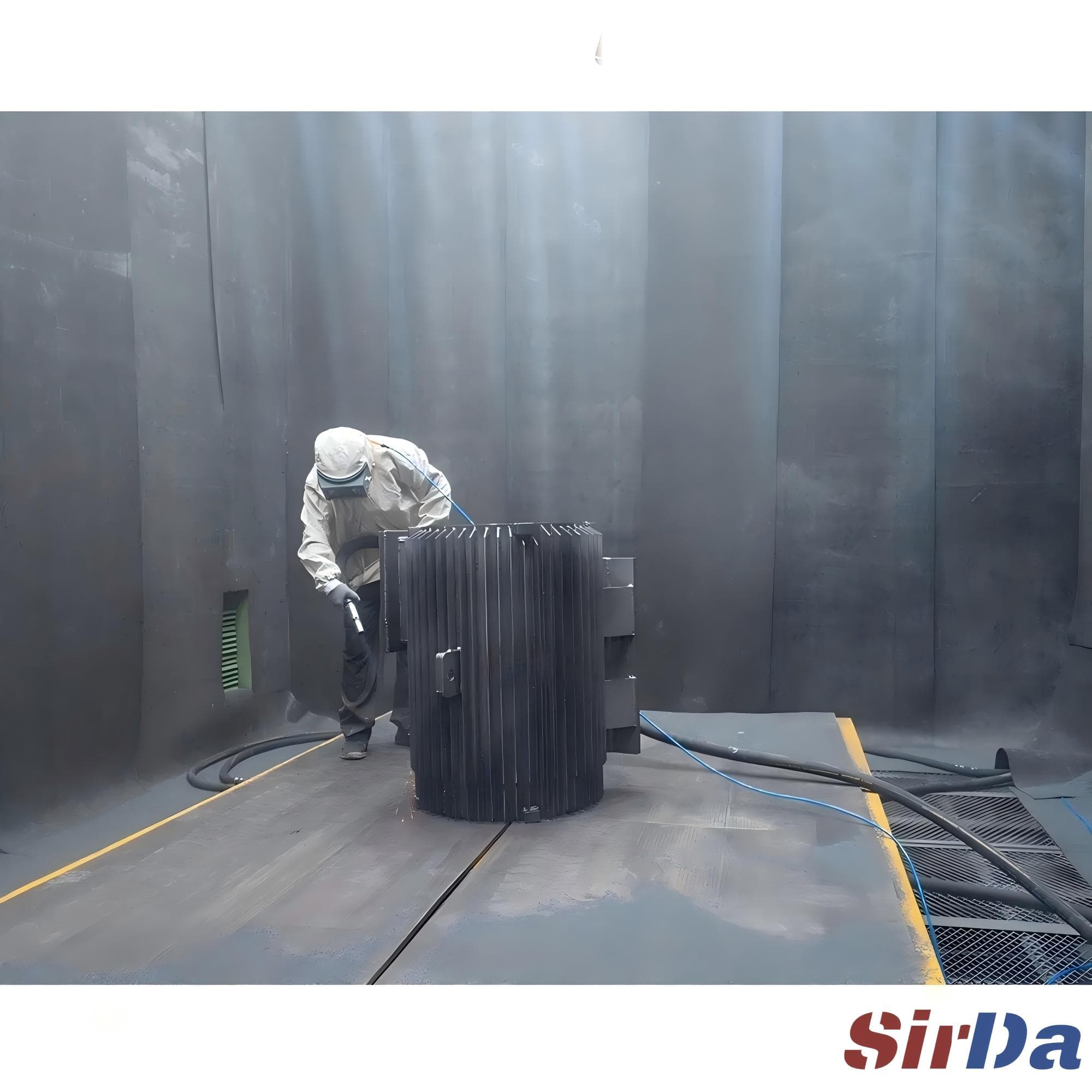
A blast room quotation is not really a machine quotation. The chamber steel is a known, comparable line item. What moves the number is the air moving through the room, the steel the media hits, and the labour assumptions wrapped around both. Most disputes over a quoted price come back to the same place: two suppliers priced different rooms, because nobody made the duty envelope explicit before either side started adding things up.
The five questions below are the ones worth settling in writing before you ask for a price. They are deliberately awkward, because each one asks a supplier to commit to something they would otherwise leave open until after the order.
The five questions that decide the price
- What is the room sized around — which part, at what weight, at what throughput? "Up to X kg" is not a duty envelope. Ask for the largest part you actually run, the batch weight, and the rate you need at that batch weight.
- What are the walls, liners and floor made of, and how thick? Grade and thickness of wear plate decide the service life of the room, not just its purchase price.
- Is the dust collector and ventilation sized for this room, or is it a catalogue figure? Room airflow, reclaim airflow and real static pressure are three different things that quotations tend to collapse into one number.
- Which wear parts will I be buying, how often, and who stocks them? Blades, liners, control cage, elevator belt, filter media. This is the running cost the quotation almost never covers.
- Who fixes it, and how quickly? A blast room sits in the middle of a production line, so response time is part of the specification.
Sizing the room around the duty, then building it to last
Capacity quoted without its basis is not a number you can plan against. A sensible supplier should be able to state which part the figure was measured on, which cleanliness standard it reached, and whether load and unload time is inside the cycle or beside it. If the answer is a single figure with no part attached, treat it as unproven.
Two details catch most buyers out. The first is presentation: a blast wheel only cleans what it can see, so a part that shadows itself will never be cleaned evenly no matter how many wheels are fitted. Rotating or re-presenting the part is usually cheaper than adding power. The second is segregation. Because media circulates through the whole machine, ferrous and non-ferrous work cannot share one circuit indefinitely — steel shot driven into a soft aluminium surface embeds iron that corrodes later, and it usually shows up after painting, when rework is most expensive. Ask whether the recovery system can be split, and what that costs.
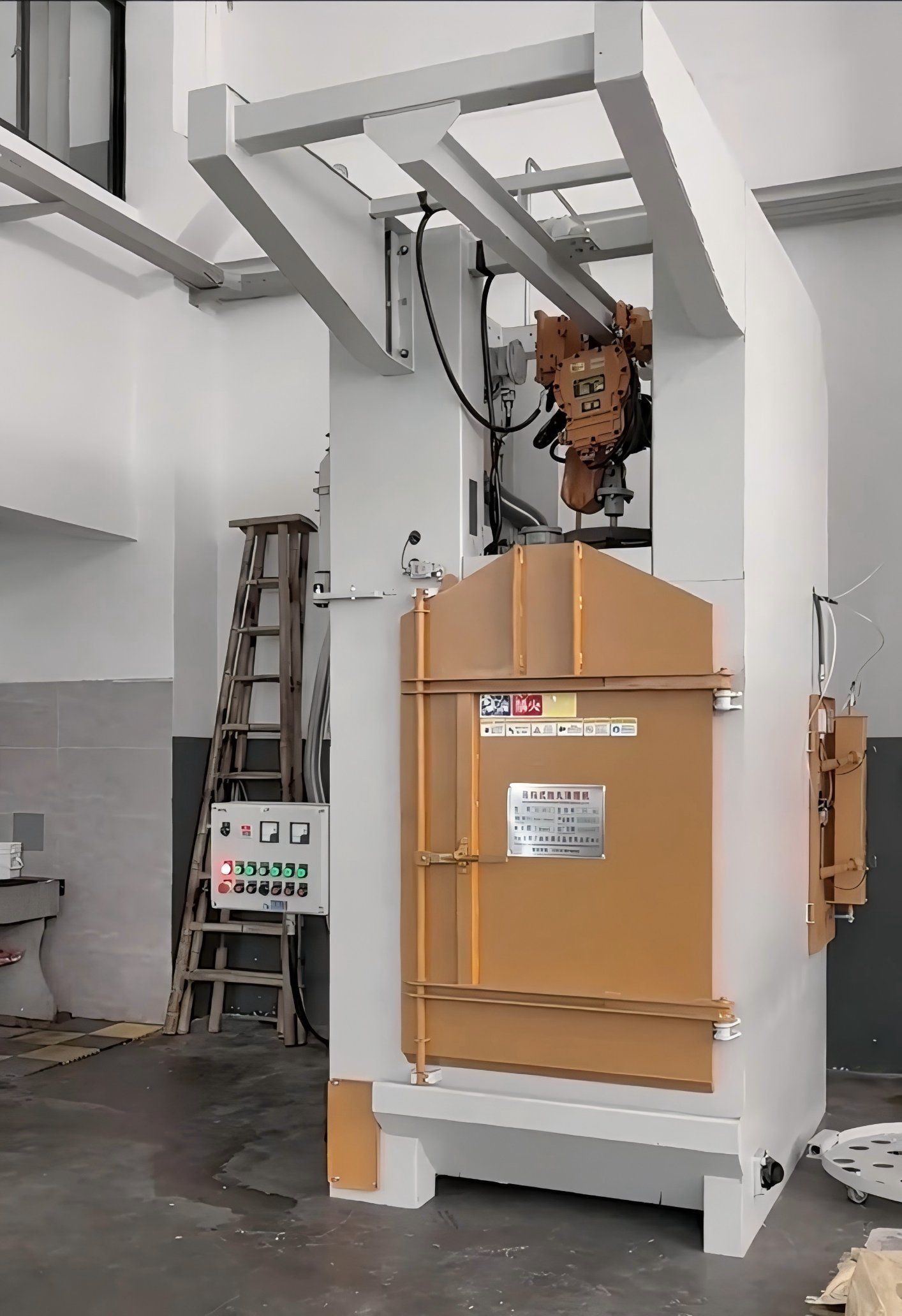
Once the duty is written down, the room itself is an abrasion-resistant container, and its life is set by the plate, not the paint. Industrial practice points to abrasion-resistant steel around AR 500, high manganese around 11–14%, or chrome-moly, and the question worth asking is the same one in all three cases: what thickness, and where. The direct blast zone in front of the nozzles takes the worst of it, and it is commonly protected by heavy rubber curtain or by manganese plates thick enough to work-harden under impact rather than wear through.
The floor is the other half of the answer. Full-reclaim systems that sweep media from the whole floor give the highest recovery and the most consistent mix; single-screw and H or U shaped layouts take less media out of the working zone and cost less to build. Sweep-in reclaim suits infrequent work but forces a shutdown for cleanup. Whatever the layout, ask how many seams and floor penetrations exist, because every one is a future leak point, and ask what keeps the doors sealed while a part is being craned in or out.
Airflow, dust collection and the reclaim loop
Cross-sectional velocity is the useful calculation for a large room: room width multiplied by height multiplied by design velocity across that face gives room airflow, and cross-draft arrangement is the economical way to achieve it. Air changes per hour is quoted constantly, but for two rooms of very different volume and the same cross-section, the air changes figure differs while the airflow requirement stays similar — which is why cross-sectional velocity is the more honest number to argue from.
Reclaim and separation add their own air on top, commonly several hundred cubic feet per minute on top of the room figure, and the fan has to deliver the total against the static pressure of the actual ductwork, plenum and filters. That is why a collector quoted at a round catalogue number is not a promise that the room receives it. Ask instead for design airflow, fan static pressure, motor power, filter area, filter type, pulse-cleaning arrangement and normal operating differential pressure, and treat those as the comparison basis.
Abrasive and substrate both load the filter, and not equally. Durable steel shot produces a different dust stream from mineral media such as garnet or aluminium oxide, while heavy scale or old coating can throw off more dust than the abrasive ever does. Cartridge collectors dominate blast rooms because pleated media packs filtration area into a small footprint; baghouses need more space and more maintenance; a cyclone upstream protects the main element from coarse debris. For fine blast dust the air-to-cloth ratio decides whether that area holds up.
Symptoms of an undersized or unbalanced system are easy to recognise after the fact: poor visibility during blasting, dust escaping when a door opens, filter differential pressure climbing faster than the filter life justifies, weak airflow at the exhaust end, and dust turning up in the workshop outside the room. None of these prove the collector is small — blocked filters, leaking ducts, wrong fan rotation and poor air inlets produce the same picture — which is exactly why static pressure and filter differential pressure belong on the maintenance schedule.
Wear parts, support and the ten-year bill
Blades, liners, the control cage, elevator belt, curtain rubber and filter media are all consumed on a schedule. Ask for that schedule, not just the list, and ask what the supplier holds in stock and how fast they can reach the rest. Media recovery rate matters for the same reason: a well-designed recovery loop returns a large share of usable media, and a poor one quietly turns into media cost and a degrading working mix. Note too that a clean, dry part left in a humid room will flash-rust before it reaches the coating line, which is a scheduling decision as much as an air-handling one.
Judge the quotations on running cost over the equipment's life rather than on the purchase price alone. A supplier who answers all five questions with drawings, airflow figures and a wear-part schedule is buying you a room you can plan production around. One who answers with a capacity number and a lead time is selling you a box.