
Choosing abrasive media for cast iron and steel castings
Media choice decides cost per tonne, surface profile and how many castings get scrapped. A practical look at shot versus grit, SAE size bands, hardness grades, the cleanliness-versus-profile distinction, and the failure modes that show up in foundry and machine-shop blasting.
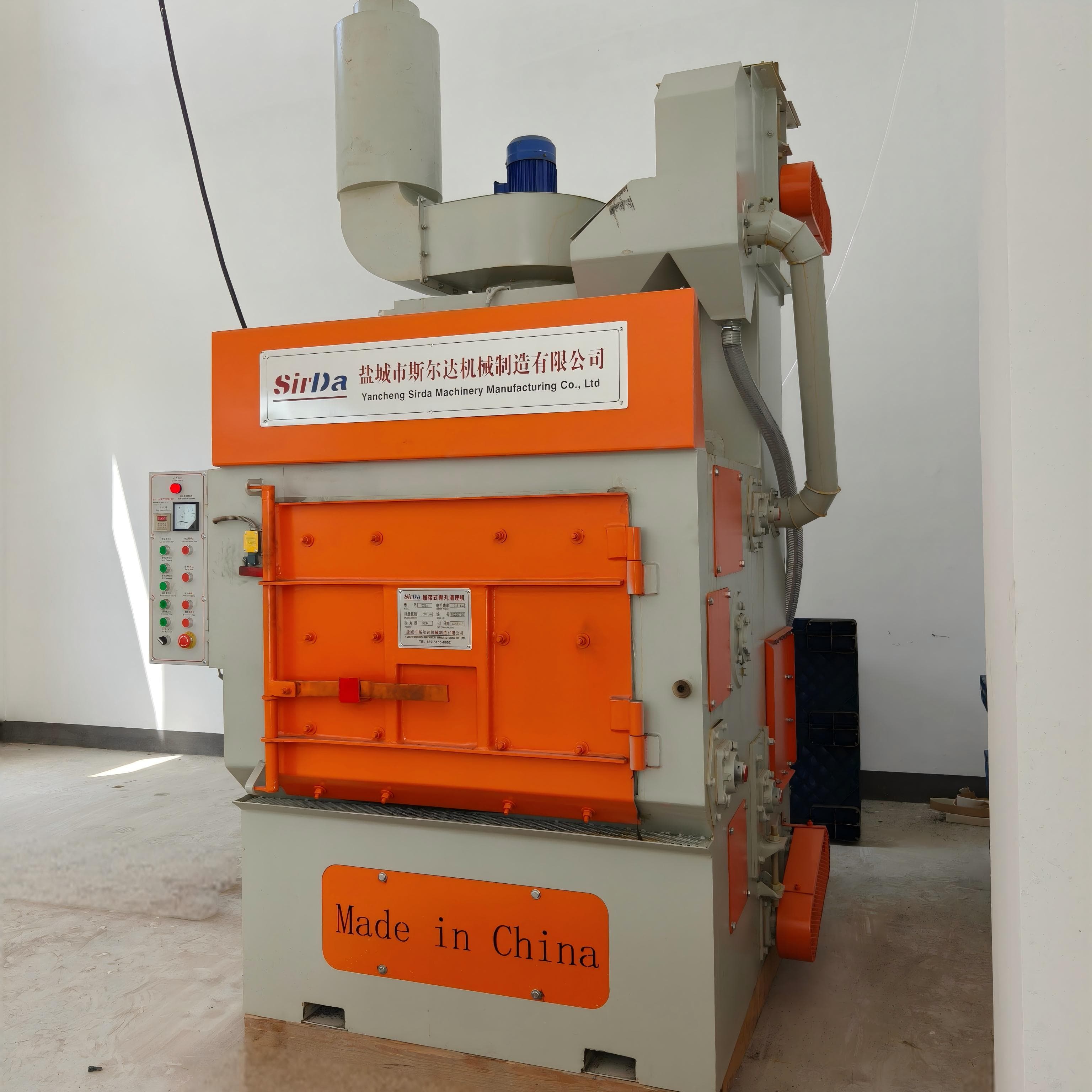
Everyone in a foundry knows the moment a casting comes out of the blast machine still carrying its moulding sand. The reflex is to blame the abrasive. In most cases the abrasive is innocent — the real causes are a media spec that was never matched to the casting, a separator cutting the wrong fraction, or a dust load that was never sized. Choosing media is a four-way decision: shape, size, hardness, and how contamination is kept out of the loop.
Start with the casting, not the media catalogue
Grey iron and cast steel are not the same substrate, and treating them identically is the most common specification error. Grey iron is brittle and flake-graphitic: angular grit at the coarse end of the range will clean it quickly, but it also concentrates stress at the graphite flakes and can chip edges and thin walls. Malleable iron and ductile iron tolerate more aggression than grey iron. Steel castings are tougher and tolerate harder media, but heavy scale and casting skin still need real cutting action.
Then add the two variables nobody writes down: wall thickness, and how much of the surface is hidden. A 4 mm casting will not survive the same treatment as a 40 mm pump housing, and an interior core surface cannot be cleaned by the impingement that a flat face can.
Shape first: what the particle does to the surface
- Spherical steel shot (S230–S460, SAE GP hardness) — rolls rather than cuts. It is the standard for foundry desanding, leaves a clean surface with low embedment, and is the only sensible choice when peening for fatigue or dimensional stability matters.
- Angular steel grit (G25–G40, GL or GH hardness) — cuts. Use it when the coating system needs a defined anchor profile, typically 50–100 µm Rz for high-performance industrial coatings, or when heavy mill scale has to come off.
- Cut wire shot — the sharper cousin of steel shot. Use where a more defined cut is needed than conditioned round shot gives, at higher consumable cost.
- Aluminium oxide or garnet (F36–F60, G25–G30) — the right answer when iron contamination is unacceptable, in stainless steel work, in food-grade applications, or in a cabinet with no steel media handling. It cuts faster than steel and dies faster too, so the cost per unit of cleaned surface is higher.
- Glass bead — cleaning and light peening only. It will not produce an anchor profile and must never be specified ahead of a coating.
Size follows shape. The SAE correspondence is a useful shorthand: S70/S110/S170 align with G80/G50/G25, S230/S280/S330 with G25, S390/S460/S550 with G18/G16/G14, and S660/S780 with G12. Castings in the first two bands are the bulk of a typical foundry workload; the coarse bands belong to heavy steel castings and tough scale.
Match the cleanliness grade, then respect the coating data sheet
Two different things get specified here, and they are routinely confused. Cleanliness is how much contaminant is left, defined by ISO 8501-1: Sa 2½ allows light staining on no more than 5% of each unit area, while Sa 3 allows none. SSPC-SP 10 / NACE 2 and SSPC-SP 5 / NACE 1 are the US equivalents. Profile is roughness, and no cleanliness standard defines it at all — it comes from the coating manufacturer's technical data sheet. Sa 2½ does not mean a coarse surface, and a Sa 3 surface can still be too smooth for the coating you are about to apply.
So the sequence is: agree the cleanliness grade, read the profile range out of the coating data sheet, then choose the media and pressure that land inside both. Verify the result against the ISO reference panel for the original rust grade under adequate lighting, and measure profile rather than judging it by eye.
Where media selection actually goes wrong in the plant
- Media consumption as a diagnostic. A healthy wheel-blast or tumble-blast process loses roughly 2–4% of the charge per cycle. 4.5–6% means something in the settings is accelerating grain breakage; above 6% needs urgent investigation.
- Air blast where a wheel belongs. Pressure-fed blasting through hoses and nozzles gives a less controlled impact pattern and far higher self-attrition than a turbine machine. If a pressure vessel is being used, higher media consumption is expected rather than a defect.
- Separator set too tight or too loose. Too aggressive and usable media goes out with the dust; too loose and dust stays in the circulation loop, grinding the working fraction down from inside.
- Worn nozzles and unstable feed. A worn nozzle distorts the stream, cuts cleaning efficiency and accelerates wear on both the part and the machine. Blockages and low media level show up as a fluctuating stream.
- Contamination in the loop. Paint residue, oil, rust fines and moisture degrade cleaning quality and can leave inclusions on a surface that is about to be coated.
- Fine dust settling on the workpiece. Over-fine fractions and airborne dust redeposit on the casting, which is critical before painting, passivation or any finishing step.
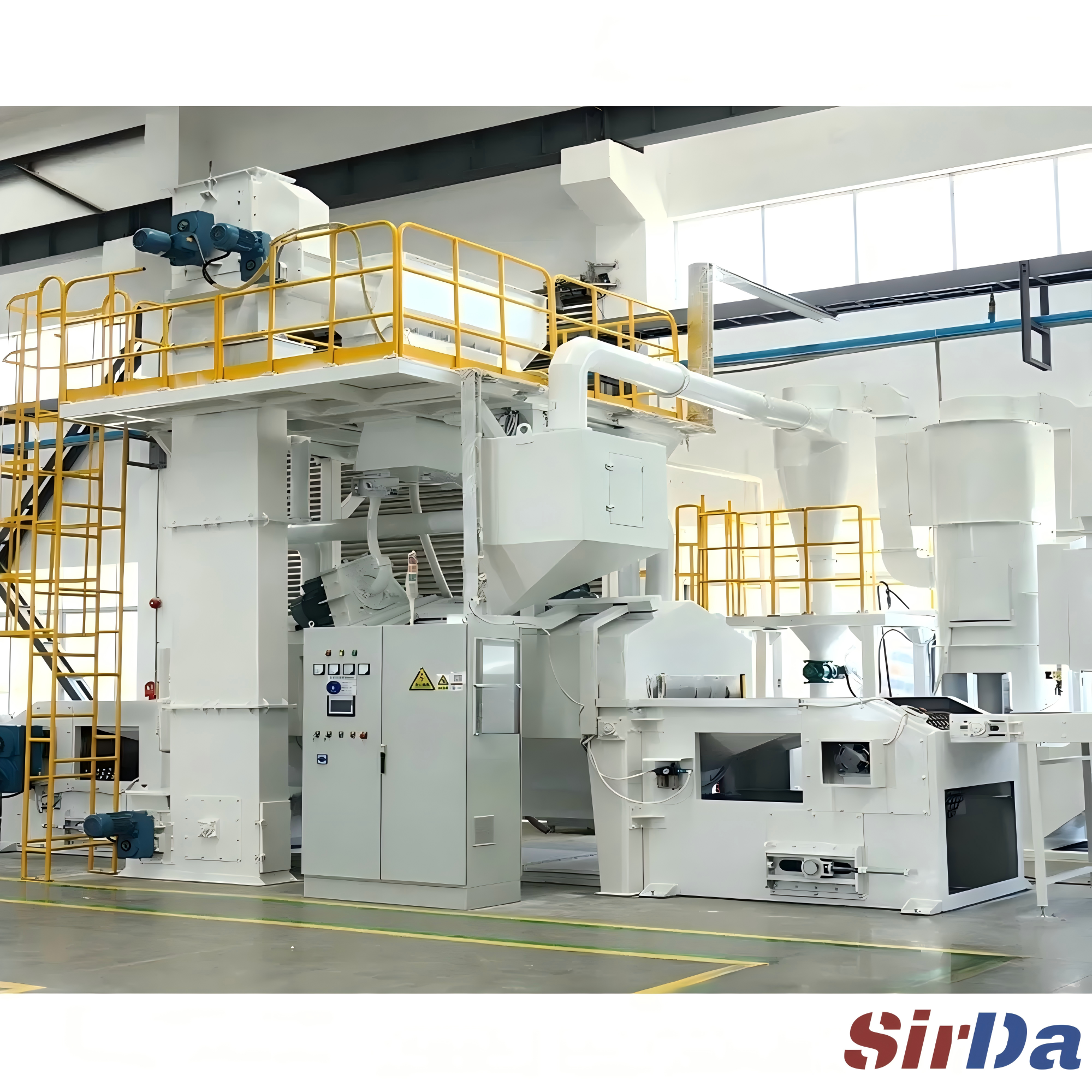
Dust and recovery are part of the media decision
The dust load is abrasive dust plus everything you removed, and the second term often dominates. Rough planning figures used in industrial blast rooms: 60–100 cfm per square foot of floor or ceiling for visibility-driven ventilation, around 100 cfm per square foot of wall for cross-draft across the workpiece, and about 500 fpm through open areas to contain dust at a cabinet. Rotary tables typically need roughly 200 cfm per square foot of opening. An abrasive cleaning or separation unit can add 600–900 cfm of its own, and that air has to be included in the collector rather than forgotten.
Keep the two duties separate. The separator recovers usable media; the dust collector handles airborne particulate. Where media is recirculated, extraction is not a substitute for a proper separator, and a blast dust collector needs a knockdown plate so that stray media is not fired straight into the filter elements.
Where to start
Write down four things before a media trial: the coating system and its data sheet profile range, the original rust grade and casting condition, the smallest wall thickness on the part, and the realistic cycle time your machine can hold. Give those four to a supplier as a specification, and ask for a media trial on your own castings with the charge weighed before and after. Three numbers decide the outcome: consumption per tonne, cleanliness against the reference panel, and profile against the coating data sheet.
If a machine is already running and media consumption is drifting upward, the cheapest diagnostic is usually a separator inspection and a nozzle check — not a change of abrasive.